Practical guide
A Before-Leave Work Handover Without Always-On Availability
Make temporary cover usable before leave: record the work, confirm capacity and authority, agree ordinary and urgent routes, and keep unanswered proposals visible. Includes three tables, four fictional examples and two editable records.
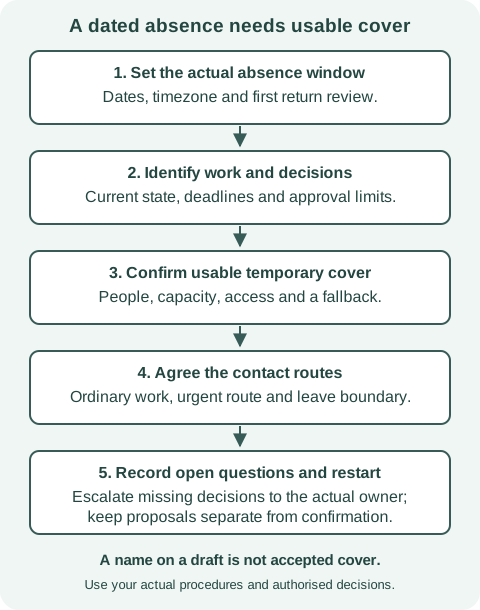
Start with a dated absence, then agree how work will continue
A useful before-leave handover tells the team what happens while you are away. It names the current work, the next action, the people actually covering it, their decision limits and the route for questions. The contact arrangement should say what you have agreed during the absence, rather than quietly assuming you will check every message.
Begin with the absence dates, timezone, last working window and expected first review after returning. “Back Monday” may be too vague for a team in several timezones or a shift that crosses midnight. Distinguish the date you return from the time you can realistically review a backlog.
This guide is for preparing an ordinary work conversation and record. Its templates are original planning aids, not an employer policy or a validated burnout intervention. If leave is sudden, work feels unsafe or health needs attention, use the appropriate workplace and professional channels directly. Completing a polished handover is not a prerequisite for getting help.
The UK Health and Safety Executive's Role standard concerns clear, understood and compatible requirements. Its Support standard includes knowing how to access support and required resources. These principles help frame the questions; neither source prescribes our table or guarantees that your proposed absence arrangement is approved.
Sort what must happen before, during and after leave
List the work that can actually affect the absence window. An existing deadline, a waiting approval, an incoming queue and an item that can wait need different arrangements. A handover should not turn every unfinished task into a promise to complete it before leaving.
Check the real deadline and the consequence of waiting. If a requirement is mandatory, retain it and identify the authorised owner who can make a timing, scope or staffing decision. You do not gain permission to skip a check by writing “defer” in a worksheet.
| Item to record | Current state | Question for the work owner | Arrangement to confirm |
|---|---|---|---|
| Deadline falls during absence | Output is partly prepared. | Who can complete it within available time? | Named cover, remaining steps, deadline and acceptance criteria. |
| Approval is outstanding | Information is prepared; permission is not granted. | Who has authority, and is the approver available? | Decision owner, limits, required approval and fallback. |
| Routine incoming queue | New work may arrive after departure. | Who receives, sorts and acts on arrivals? | Coverage window, queue location and escalation rules. |
| Item can wait until return | No earlier requirement has been confirmed. | Who can confirm the later timing? | Actual agreed date, affected parties and restart owner. |
| Cover lacks time or access | A person is proposed but cannot yet perform the task. | Which capacity or resource decision is still needed? | Missing condition, authorised owner and decision window. |
| Critical fact is unresolved | Deadline, owner or risk information is unclear. | Who can clarify it before the affected work? | Unknown field stays visible; do not mark it covered. |
| New request arrives before departure | It adds work to an existing plan. | What changes in scope, timing or assignment? | Updated plan and confirmations rather than an invisible extra promise. |
HSE's Demands standard includes adequate and achievable demands in relation to agreed hours. A table makes a capacity gap visible; it does not create extra hours for you or the person covering. If the preparation and handover themselves require time, include that work in the plan.
For a wider hours or priority conflict, use the workload priorities guide linked below. Keep the leave note focused on the work that will need a route during this particular absence.
A proposed contact is not confirmed temporary cover
Ask the receiving person or appropriate manager to confirm the coverage dates, tasks and limits. Check whether the person has the needed access, information, skills and time. A friendly offer to “keep an eye on things” may cover monitoring but not delivery, approval or an entire queue.
| Cover question | Confirmation to seek | Assumption to avoid |
|---|---|---|
| Which dates and work are covered? | Actual absence window and specified outputs or arrivals. | One helpful reply covers every day and task. |
| What can the person decide? | Decision rights and the limits of that authority. | Covering a queue authorises a contract or vendor exception. |
| Can they use the work? | Current version, approved location and legitimate access. | A link guarantees access or permission. |
| Do they have capacity? | What other work changes if cover adds a material load. | Naming someone creates time in their schedule. |
| What counts as received or complete? | Relevant receipt and acceptance checks. | A sent message is automatically accepted. |
| What if the cover is unavailable? | Usable backup or escalation owner and route. | The absent worker becomes the fallback by default. |
Keep approvals separate from operational receipt. Someone can confirm that they received the work without approving the outstanding exception inside it. If a decision requires more than one authorised approval, list the actual arrangement rather than forcing it into a one-person model.
A draft question is: “Could we confirm who handles the queue from [start] to [end], what they can decide, and where an exception goes? [Condition] is still missing. Who can decide the capacity or access change before [affected work]?” Adapt it to the real procedure and keep unanswered questions marked as open.
Store the actual documents in an approved work location. A general planning card can use task labels and links without reproducing customer records, credentials, private health details or other information that does not belong in it. Obtain access through the normal authorised process.
Agree ordinary questions, genuine urgency and your leave contact boundary
The team needs a usable route for work; you need a clear statement of the arrangement during your absence. Write both. “I will be away, but message me if needed” leaves the threshold, channel and response expectation open. It can turn the person on leave into the first contact for routine questions.
Use the organisation's actual urgent-work or incident procedure where one exists. This guide supplies no universal emergency definition, response time or legal entitlement to disconnect. A requester writing “urgent” does not by itself establish which procedure applies.
| Situation | Route or decision to confirm | What the note should not imply |
|---|---|---|
| Ordinary task question | Named cover or agreed team queue with current work location. | Every question first goes to the person on leave. |
| Time-sensitive decision | Authorised decision owner and a backup within the real deadline. | A monitoring colleague can grant any approval. |
| Work incident or genuine emergency | Existing applicable incident or urgent route. | A generic article replaces safety or incident procedures. |
| Cover is unavailable | Appropriate manager or agreed fallback decides the next arrangement. | The absence is cancelled by an unanswered message. |
| Specific leave-worker contact is proposed | Whether contact is agreed, for what condition, by whom and through which channel. | A broad promise to monitor all channels or respond instantly. |
An ordinary absence-message draft could say: “I am away [dates/timezone] and, under the agreed arrangement, will not monitor this inbox during that period. For [work], contact [confirmed route]. For [locally defined urgent category], use [existing route]. My first planned review of messages is [window].” Only describe monitoring and response arrangements that have actually been agreed or established for your role.
If limited contact is specifically agreed, record its conditions and channel without expanding it into routine availability. Confirm the actual expectations through the appropriate work arrangement. The worksheet cannot override an on-call duty, contract, formal leave process or applicable policy.
Four fictional examples of a handover gap
These invented examples illustrate work decisions. They make no claim about your employer's staffing, policy, approval rights or the result of asking.
1. The queue receiver cannot approve an exception
Maya will be away for four working days. Leo agrees to receive the operations queue. One case still needs procurement approval. Maya's draft says Leo “owns everything” during leave.
Clearer note: Leo receives and sorts the queue during the confirmed window. Procurement remains the exception approver; the named procurement backup and the required decision time are still to be confirmed.
The outstanding approval stays visible. Receiving the queue does not turn Leo into an authorised procurement approver.
2. A colleague volunteers but lacks time
Jon offers to cover Priya's report while she is away. His existing deadlines already occupy the available work window, and the report requires a system he cannot yet access.
Clearer note: Jon is proposed for the report; capacity and access remain unresolved. The manager needs to confirm a workload change or another assignment, and the authorised access process must be completed.
A volunteered name is useful information, not proof that the output can be delivered. Priya should not solve that gap by silently promising evening availability.
3. The absence message routes routine work to the worker on leave
Ellis drafts “Text me for anything important” even though a team lead has confirmed ordinary queue cover. The team has not agreed what important means or whether leave contact is needed.
Clearer proposal: Route ordinary questions to the confirmed queue cover. Ask the manager to confirm the time-sensitive and incident routes and whether any specific leave contact is actually required.
This is a request for an arrangement, not a unilateral rewrite of duties. The final absence message should match what is confirmed.
4. The first return morning is already full
Sam expects to return for a morning shift with a scheduled customer session. The draft promises a reply to every accumulated message at the start of that shift.
Clearer proposal: Confirm who handles arrivals up to the return transition and set a realistic first review window after the scheduled session. Record which urgent items need a route before that review.
Returning to work and clearing a backlog are different events. A dated review window helps avoid making an unworkable promise.
Ask for confirmation and keep the current version visible
Share the permitted work record through the normal team process before the relevant handover. Invite the people who actually receive, decide or allocate cover to confirm their part. Mark each item proposed, confirmed, disputed or unknown; these are ordinary record labels rather than scores.
A manager-conversation draft is: “I am preparing the handover for [absence window]. [Work] needs coverage and [approval] remains separate. The proposed contact route is [route]. Could we confirm capacity, the decision limits and the fallback? If [item] cannot fit before departure, who can decide the change?”
After a discussion, record the actual decisions: “Confirmed: [cover, tasks and dates]. [Role] retains [approval]. Unresolved: [question], to be decided by [authorised owner] before [affected work]. Contact during leave follows [confirmed arrangement]. The current record is [approved location/version].” A proposal and a sent message remain proposals until the relevant confirmation exists.
Update the note if a deadline, absence date, cover person or approval route changes. Make the current version easy to find and tell affected people through the agreed process. A new paragraph in a private copy does not update the team's accepted arrangement.
If confirmation does not arrive, identify the missing decision and use the appropriate workplace route. Keep the gap factual. Do not infer agreement from silence, copy recipients or a colleague's senior title. For general uncertainty about ongoing duties, use the separate role-clarification guide; the present record concerns temporary absence cover.
Copy the handover and decision records
Use one work row per item that needs a route during the absence. The second card captures a decision or contact question that would otherwise be hidden inside a broad promise. Leave unknowns visible and record who can resolve them.
BEFORE-LEAVE — WORK AND COVER RECORD
Absence dates / timezone / last working window:
Expected return and first review window:
Work item / current version / approved location:
Current state and next required action:
Actual deadline / consequence of waiting:
Proposed cover / confirmation / coverage dates:
Decision owner / authority limits / separate approval:
Access and capacity confirmed, or still missing:
Fallback route if cover is unavailable:
Confirmed change / unresolved question / decision needed by:
Leave-period contact arrangement and confirmation:
Keep proposals separate from confirmed arrangements.
BEFORE-LEAVE — DECISION AND CONTACT CHECK
Question or exception requiring a decision:
Who has authority for that decision:
Proposal / confirmed / disputed / unknown:
Permitted decision and limits:
Required approval still outstanding:
Normal work route during absence:
Locally agreed urgent route and qualifying conditions:
Backup and what happens if unavailable:
Leave-worker contact, only if specifically agreed:
Who confirmed the arrangement / when / version:
Return review window and who updates the record:
Silence, a copied email and a contact name are not confirmation.
Download two records, three reference tables and six explained cases. These are editable original prompts; keep actual work information in its approved location.
Case 1
You send a handover to a colleague and receive no reply. Is temporary cover confirmed?
Show answer and explanation for case 1
No. Keep the proposal and sending status separate from confirmation.
Use the actual receiving and allocation process to establish cover, dates and tasks. Silence or a copied message does not show that the colleague has accepted or has capacity.
Case 2
Your cover agrees to receive a queue containing an outstanding contract exception. Does receipt approve the exception?
Show answer and explanation for case 2
No. The separate approval remains outstanding.
Identify the actual authorised decision owner and limits. Receiving or sorting work does not grant authority for every decision inside it.
Case 3
A helpful colleague is named in the plan but lacks required access and available time. Is the output now covered?
Show answer and explanation for case 3
Not yet. Record the missing conditions and seek the relevant decisions.
Capacity and legitimate access are usable resources, not consequences of writing a name. Ask the authorised owner for an assignment or workload decision and follow the normal access process.
Case 4
Your draft says you will check all work channels during leave, but no contact arrangement has been confirmed. Should that promise go into the final note automatically?
Show answer and explanation for case 4
No. Confirm the actual leave-period contact arrangement first.
Clarify ordinary work, urgent routes and any specific leave-worker contact through the appropriate work process. The template neither assumes always-on availability nor overrides existing duties.
Case 5
A new task is called urgent just before departure. May you silently skip its mandatory approval to finish sooner?
Show answer and explanation for case 5
No. Keep the required approval and ask the authorised owner about the conflict.
A requester label or handover note does not waive a mandatory check. Scope, time, staffing and decision routes may need an authorised change.
Case 6
Health needs attention or the situation feels unsafe while the handover is still incomplete. Must you finish every field before using support?
Show answer and explanation for case 6
No. Use appropriate support and the applicable work process directly.
This is an optional planning aid, not a health assessment or an eligibility test. It should not delay care, urgent support or attention to unsafe work.
Review the return window without making leave a burnout test
At the agreed return review, check what changed, which decisions were made and what still needs action. Update the current work record rather than immediately resuming every old commitment as though nothing happened. If temporary cover continues through part of the return day, confirm that transition too.
A planned absence is not proof that workload is repaired or that health concerns have resolved. WHO's ICD-11 explanation identifies burnout as an occupational phenomenon associated with chronic workplace stress that has not been successfully managed, rather than classifying it as a medical condition. This handover cannot diagnose burnout, assess readiness for a clinical return to work or select treatment.
Use the relevant workplace, occupational-health or qualified professional channels for health, safety, leave eligibility and employment-rights questions. Formal leave and on-call arrangements depend on your actual circumstances. HSE is UK guidance; its legal context is not a worldwide description of rights or employer duties.
For a broader question about draining work conditions versus job fit, use the guide linked below. Keep that larger review separate from the practical question this note answers: who can continue the work during a defined absence, within what limits and through which confirmed contact route?
Sources and further reading
- HSE Management Standards: RoleClear, understood and compatible requirements and local routes for uncertainty; does not prescribe this leave template or grant decision authority.
- HSE Management Standards: SupportKnowing how to obtain usable support and required resources; no assumption that a proposed cover person is available.
- HSE Management Standards: DemandsAdequate and achievable demands in relation to agreed hours; no invented capacity or universal leave-contact rule.
- WHO (2019): Burn-out as an occupational phenomenon — ICD-11Occupational definition and classification boundary; holiday or handover completion not a diagnostic or recovery test.