Practice worksheet
Job Fit vs Skill Gap: A Career Reflection Worksheet
Compare a task’s requirements with observed ability and the conditions around the attempt. Agree useful support, then review learning and core-work fit separately. Includes an editable evidence card and seven explained checks; no diagnostic or job-fit score.
Ask about one task, not your worth as a worker
A skill gap is a specific capability needed for a task that you have not yet demonstrated or learned. Job fit is a broader question about whether the role’s recurring work and conditions suit what you can do, want to do and need. Both can be involved. Difficult work can also reflect unclear standards, excessive volume, missing tools or unavailable support. Start with a concrete task before choosing a label.
For example, “I need to learn the approved reconciliation method” names a possible learning need. “I can do this work, but I do not want repeated travel to be a core part of my role” raises a different fit question. “The inputs arrive after the deadline” names a work condition; another course alone cannot make the missing input arrive.
This original worksheet helps prepare a career or work conversation. It is not a validated assessment, a competence certification, a burnout test or a recommendation to stay or leave. You do not need to finish it before seeking support for a health or urgent work concern.
The demands and resources record checks whether needed support is usable. The responsibilities checklist clarifies ownership and authority. Here the distinct task is comparing a specific capability requirement with actual performance evidence and a supported attempt.
Separate capability, conditions, preferences and health concerns
The HSE Demands standard includes matching skills and abilities to job demands, designing work within employees’ capabilities, and making demands achievable within agreed hours. Its Support standard includes necessary resources and regular constructive feedback; its Role standard calls for clear and compatible requirements. [1–3] These are work-design questions, rather than reasons to attribute every difficulty to an individual.
| Question | Useful evidence | Conclusion to avoid |
|---|---|---|
| Can I perform the specific task? | An agreed standard, a located difficulty, suitable instruction and observed work. | One mistake establishes that I cannot do the profession. |
| Can the task be done under these conditions? | Time, usable inputs, access, competing work and support during the attempt. | Training fixes a missing input or unrealistic volume. |
| Would the core work suit me if conditions were workable? | Repeated task experience, what the role actually requires and preferences to discuss. | Disliking one assignment proves that every version of the role is unsuitable. |
| Is a health concern affecting functioning? | Your concern and an appropriate professional or support conversation. | A worksheet can diagnose burnout or rule out other conditions. |
Use “unknown” when the evidence is missing. An unfamiliar task before instruction is not the same as a demonstrated inability after suitable practice. Equally, confidence and interest are not proof that an essential skill has been demonstrated.
WHO’s ICD-11 account treats burnout as an occupational phenomenon associated with chronic workplace stress, rather than a medical condition. [4] This worksheet cannot distinguish it from other health concerns or determine readiness for work. Keep that question separate from a career comparison.
Turn “I am not good at this” into an observable requirement
Choose one recurring task that matters to the role. Describe the required output and the person or procedure that establishes acceptable work. Replace a broad adjective such as “strategic,” “confident” or “a natural leader” with something that can be discussed: explaining a decision with its assumptions, checking a record against an approved method, or arranging an agreed handover.
Record the specific difficulty. Did you omit a required field, misunderstand a category, struggle to explain a recommendation, or run out of time because another queue was assigned simultaneously? Those observations point toward different next questions. They are more useful than a single judgment of being “bad at the job.”
Write what you can already demonstrate, with its scope. Completing routine cases is evidence about routine cases, not every complex exception. Preparing a sound recommendation is not the same as holding authority to approve it. Keep quality, speed, independence and decision rights separate.
Ask for a reference when the requirement is unclear: “Could we review an acceptable example and the criteria you will use to assess this task?” HSE’s Role standard supports clear requirements and routes for raising uncertainty. [3] A private self-rating cannot settle conflicting instructions from two reviewers.
Use a brief description of work, not confidential records, in a general reflection sheet. An approved workplace location can hold the actual example when the reviewer needs it.
Record the conditions around the attempt
A performance observation needs context. Put the instructions, task complexity, usable time, tools, inputs and support beside it. Note whether the standard changed or required information arrived late. A comparison becomes less informative when it quietly treats different tasks as equivalent.
For a possible learning need, ask what teaching and feedback would address the specific step. HSE’s Support standard includes knowing how and when to access support and receiving constructive feedback. [2] An invitation to training does not establish that useful instruction or feedback has already occurred.
For a work-condition problem, ask the person with authority for a relevant adjustment. If the output is clear and routine work is manageable but the assigned volume does not fit agreed hours, the next request may concern workload. If an essential input is missing, record that dependency. Do not convert either into a personal learning deficit merely because you were the person holding the unfinished task.
Keep several explanations open when appropriate. A new method may need practice while interruptions also reduce usable time. A worksheet row can name both; it does not need to force a binary choice to be useful.
Agree a supported attempt with clear comparison criteria
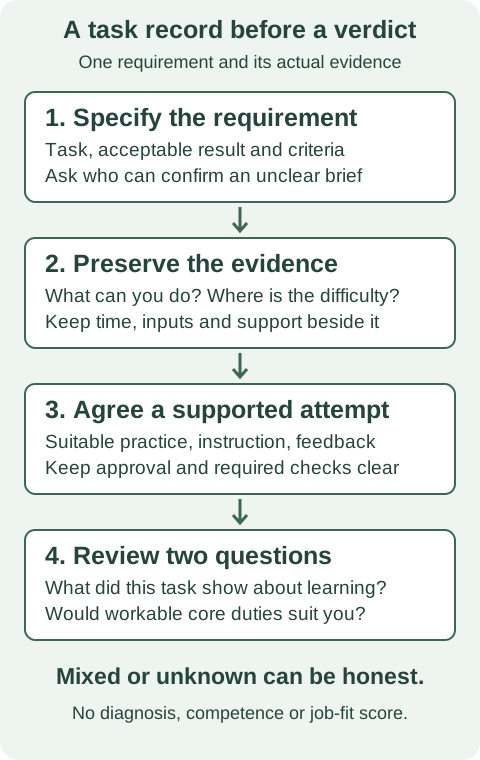
A useful next step may be suitable instruction, a worked example, supervised practice, a clearer brief or a work-condition adjustment. Choose the change that addresses the observed gap. Confirm it with the appropriate person, including time, support, feedback and the work you will compare afterwards.
Do not make an unapproved experiment out of required checks, customer commitments or duties. Use an appropriate learning setting and the established requirements of the actual task. This page does not establish that a reader is qualified to perform a particular activity independently.
The following example is fictional. It illustrates how evidence can become clearer without turning a short practice exercise into proof of job fit or professional competence.
| Stage | Observed work and conditions | What can be said |
|---|---|---|
| First attempt | A new analyst drafts a summary. The reviewer says that important exceptions are missing; the brief does not identify how exceptions should be grouped. | There is a specific quality concern and an unclear criterion. A permanent ability verdict is premature. |
| Supported practice | The reviewer supplies an acceptable example, explains the grouping rule and checks one draft in a suitable practice setting. | The method and feedback are now more concrete. Instruction received is not itself proof of independent performance. |
| Next agreed task | With the same criteria, the analyst includes the required exception groups. A new data source still needs guidance. | The observed grouping step improved in this task. The new data source remains a separate learning question; overall fit is unresolved. |
For a real comparison, name the criterion before reviewing the result. “The required exception groups are included” is more informative than “I feel better.” Keep independence and support level visible, and record any other change in the conditions.
One improvement does not isolate its cause. A clearer brief, teaching, extra time and helpful feedback may all have changed together. Record that honestly. An unsuccessful attempt can likewise leave several explanations open, including whether the support addressed the actual step.
Review the skill evidence and the core-work question separately
After the agreed attempt, compare the required result with the observed result and the support actually received. State the narrow learning: which step is now clearer, which capability was demonstrated, what still needs feedback, and which work conditions remain unresolved. Keep the earlier record so that the change is visible.
Then ask about core work: “If this task were adequately supported and the volume manageable, would I want it to remain a substantial part of my role?” You may be capable of a task you do not want to repeat, or interested in work for which you still need training. Both deserve an honest note; neither automatically settles a career choice.
Possible next moves include a further specific learning request, a discussion of work design, a task or team change, or investigating another role’s actual requirements. The role-redesign guide helps define a proposed arrangement and review its implementation. The transferable-skills guide compares existing evidence with a different role.
If a trial was not agreed or the promised support did not happen, record that result. It is information about the feasibility of the arrangement, not proof that you failed to learn. Continuing indefinitely is not a requirement of this worksheet. Wider decisions need your actual alternatives, finances, obligations and suitable advice.
Seven checks on a career conclusion
Answer these original fictional cases before opening the explanations. The aim is to choose a better question, not produce a job-fit or burnout score.
Case 1
A new task went badly before you received the method or an acceptable example. Does this establish a permanent skill deficit?
Show answer and explanation for case 1
No. Clarify the requirement and suitable instruction before drawing that conclusion.
The observed difficulty is real, but the conditions and criteria remain incomplete. Record the task-specific learning question.
Case 2
You can do a routine task to the required standard, but dislike it as the main duty of a future role. Is more technical training the only relevant next step?
Show answer and explanation for case 2
No. Record the capability evidence and discuss the recurring core-work preference separately.
Being able to perform a task and wanting it to dominate a role are different questions. One dislike alone still does not settle every possible version of the role.
Case 3
Two reviewers request incompatible outputs. Should you simply rate your skill lower?
Show answer and explanation for case 3
No. Ask who can confirm compatible criteria.
An unclear standard cannot be resolved by a self-rating. The requirement needs clarification before the performance comparison is meaningful.
Case 4
A training session is completed, but there is no observed application or feedback. May the record say independent competence is demonstrated?
Show answer and explanation for case 4
No. Record instruction received and the next suitable work evidence still needed.
Participation, a supported attempt and independent performance are distinct evidence. The worksheet cannot certify professional competence.
Case 5
Your report improves after coaching, a clearer brief and extra time all arrive together. Has coaching alone been proved to cause the improvement?
Show answer and explanation for case 5
No. Record the improvement and all conditions that changed.
A useful work observation does not isolate a cause. The result can guide the next discussion without being treated as a controlled research experiment.
Case 6
The promised reviewer was unavailable and the practice never happened. Does that prove you cannot learn the skill?
Show answer and explanation for case 6
No. Record that the agreed support or attempt did not occur.
A missing learning opportunity is not evidence of failed learning. Ask whether another arrangement is feasible or consider the broader work options.
Case 7
A career worksheet is unfinished while work is affecting your health or feels unsafe. Must you complete the comparison before seeking support?
Show answer and explanation for case 7
No. Use appropriate support for the actual concern now.
This record supplies no waiting rule, diagnostic threshold or eligibility score. Work reflection and needed support can proceed separately.
Copy the task record and use support when needed
A concise conversation draft is: “For [task], the required result is [criterion]. My current evidence shows [specific capability], while [step] remains difficult under [conditions]. Could we agree [instruction or adjustment], who provides feedback, and the next suitable task to review? I would also like to discuss whether [recurring core duty] should remain part of the role.”
That draft separates a learning request from a work-choice question. It does not send a message or commit anyone’s time. After the conversation, distinguish a confirmed arrangement from a proposal or unanswered request.
JOB FIT / SKILL REQUIREMENT — ONE TASK RECORD
Task and expected result:
Who confirms the requirement and quality criteria:
Specific capability required, not a personality adjective:
Evidence of what I can already do:
Observed difficulty and its location in the task:
Time, instructions, access and support in that attempt:
What remains unclear or untested:
One proposed learning or work-condition adjustment:
Person who can approve it; confirmation status:
Suitable practice setting, feedback and required checks:
Expected work outcome; comparison criteria:
Review point chosen for this task:
What actually happened; support actually received:
Other conditions that also changed:
What I learned / what this does not establish:
Core work I would or would not want under workable conditions:
Next question or agreed action:
This record produces no diagnostic, job-fit or competence score.
Download the task record, worked example and seven explained checks (TXT). Keep it in a location appropriate for your notes. The page does not collect or evaluate your answers.
HSE’s overview identifies work-design factors and appropriate conversations with line management, a worker representative, a GP or occupational-health support. [5] Use suitable local support for the concern you actually have. Health symptoms, unsafe conditions or questions about rights do not need to wait for a completed reflection sheet or a particular score.
HSE guidance is written for the UK; its legal statements are not a worldwide account of employment rights. Our worksheet and fictional examples do not assign workplace authority, determine accommodations or validate a hiring decision. For the broader starting question, return to burnout or a bad job fit.
Sources and further reading
- HSE Management Standards: DemandsSkills and capabilities matched to demands; achievable work within agreed hours. Not validation of this worksheet.
- HSE Management Standards: SupportUsable resources, knowing how and when to access support, regular constructive feedback.
- HSE Management Standards: RoleClear and compatible requirements, understood responsibilities and routes for uncertainty.
- WHO (2019): Burn-out as an occupational phenomenonOccupational context and classification boundary; no reader diagnosis or exclusion of other health concerns.
- HSE: Work-related stress—overviewWork-design areas and appropriate workplace, GP and occupational-health support; UK legal statements not generalised.