Chronic Workload Overload: What to Record and Change
Revised · Work-planning information
A recurring workload problem becomes easier to discuss when you can show what keeps arriving, what can realistically be completed and which tradeoffs remain undecided. A work record does not diagnose burnout or make an unsafe situation acceptable.
Look for a recurring mismatch, not a personality explanation
Workload overload describes a mismatch between what the work requires and the usable time, staffing, skills or resources available to do it. A full calendar alone does not settle the question. A useful record shows the commitments, what changes them and what remains unfinished or displaced.
Here, ‘chronic’ means the mismatch keeps being recreated. This page supplies no number of days that proves chronic overload or burnout. You can raise an immediate capacity or safety concern without waiting for a pattern to last a week. Repeated observations help explain the work system; they are not a condition for getting help.
HSE’s Demands standard concerns workload, work patterns and the work environment. It describes adequate, achievable demands in relation to agreed working hours, matching demands to people’s abilities, and responding to concerns. That is a work-design reference in a UK context, not a formula for calculating a person’s health or a guarantee that a particular request will be approved.
Separate demand, available time and waiting
Start with the work you have already committed to and the new work being requested. Include routine work, meetings, handovers and required checks rather than treating the whole working week as uninterrupted task time. Use the same planning period and unit when comparing estimates.
For example, an illustrative plan has 20 hours available for project work after other agreed duties, while its project tasks are estimated to need 26 hours. The six-hour difference is a planning gap under those assumptions. It does not prove that the estimates are correct, that overtime is authorized or that the worker has burnout. Show the assumptions beside the comparison.
Keep elapsed waiting time separate from hands-on effort. A task blocked for three days by an approval is not automatically three days of work. It can still threaten a deadline. Record the missing input, who can provide it and what other work can proceed; do not inflate the effort total to make the problem look persuasive.
Build a record that makes the work change visible
On a narrow screen, scroll the table sideways to read all columns.
| Observation | Useful detail | Decision it can support |
|---|---|---|
| Work already committed | Output, owner, deadline and current estimate | What is being displaced by the new request? |
| New or changed demand | When it arrived, what changed and who requested it | Does scope, timing or priority need reconfirming? |
| Usable work time | Agreed duties, coverage, meetings and known absences | Is the plan using time that is actually available? |
| Block or dependency | Missing input, decision owner and effect on delivery | Who can remove the block or revise the deadline? |
| Work displaced | What was deferred, interrupted or left unfinished | Which consequence needs an explicit choice? |
| Support needed | Access, skills, staffing or an unresolved work concern | What support must be provided, and by whom? |
Use ordinary work descriptions and approved storage. A planning record rarely needs customer names, private health information or copies of confidential messages. Keep the evidence traceable in the appropriate work system without moving sensitive material into an unsecured personal note.
Ask what is recreating the mismatch
A temporary increase with a clear end, workable cover and an agreed reprioritization is different from new demands repeatedly arriving without anything being removed. Check whether the same process keeps adding work: changing scope, several request channels, missing cover, unplanned rework or a backlog carried into each new planning period.
Do not assume that every unfinished task has the same cause. If the work fits the available time but essential access or training is missing, the immediate question concerns resources or skills. If two instructions cannot both be met, record the conflict rather than describing it only as a long to-do list. The related guides below help keep these questions separate.
WHO’s mental-health-at-work fact sheet lists excessive workload, work pace, understaffing and low control among psychosocial risks. It recommends addressing working conditions through organizational interventions. That supports examining the work arrangement; it does not establish that a particular worker’s symptoms have one cause or that a worksheet will improve health.
Turn the observation into a decision that someone can answer
Choose the person or process with authority to change the relevant part of the plan. A requester may want an urgent output without being able to alter another team’s deadline or provide staffing. Make that gap visible instead of assuming that the person nearest to the request can resolve it.
A draft question could be: ‘The current plan includes A and B, and C was added today. With the available work time and these estimates, I cannot confirm all three deadlines. Which output, scope or deadline should change, and who needs to confirm that decision?’ Adapt the wording to your role and the actual facts.
Options might include reducing scope, changing a deadline, reallocating work, providing a missing resource or agreeing which work is deferred. They are proposals until the appropriate owner confirms them. Do not remove required safety checks, bypass a service obligation or assume unpaid or unapproved extra work solves the gap.
Review what was implemented, not just what was promised
Record the decision, who made it, who needs the update and whether the change actually reached the work plan. A discussion that ends with ‘we will look at it’ leaves the operational question open. State what remains undecided and when the responsible person expects to respond.
At an agreed review, compare the actual commitments, available support and displaced work with the earlier record. A new deadline may help one task while leaving the same overload process in place. Clearer records can reveal that remaining problem, but they cannot guarantee approval, recovery or a manageable job.
Keep support separate from the planning exercise
Workplace planning and personal health support can happen alongside each other. You do not need a website score or a complete evidence log before discussing concerning health or functioning changes with an appropriate professional. HSE’s overview points to options such as a line manager, worker representative, GP or occupational health team; the routes available to you depend on your circumstances.
WHO describes burnout as an occupational phenomenon in ICD-11, rather than a medical condition. That classification is not reassurance that symptoms are harmless. A possible emergency or immediate safety concern needs the appropriate immediate response, rather than waiting for a workload meeting or completing this page. Employment rights, benefits and disputed workplace obligations need advice suited to the relevant jurisdiction.
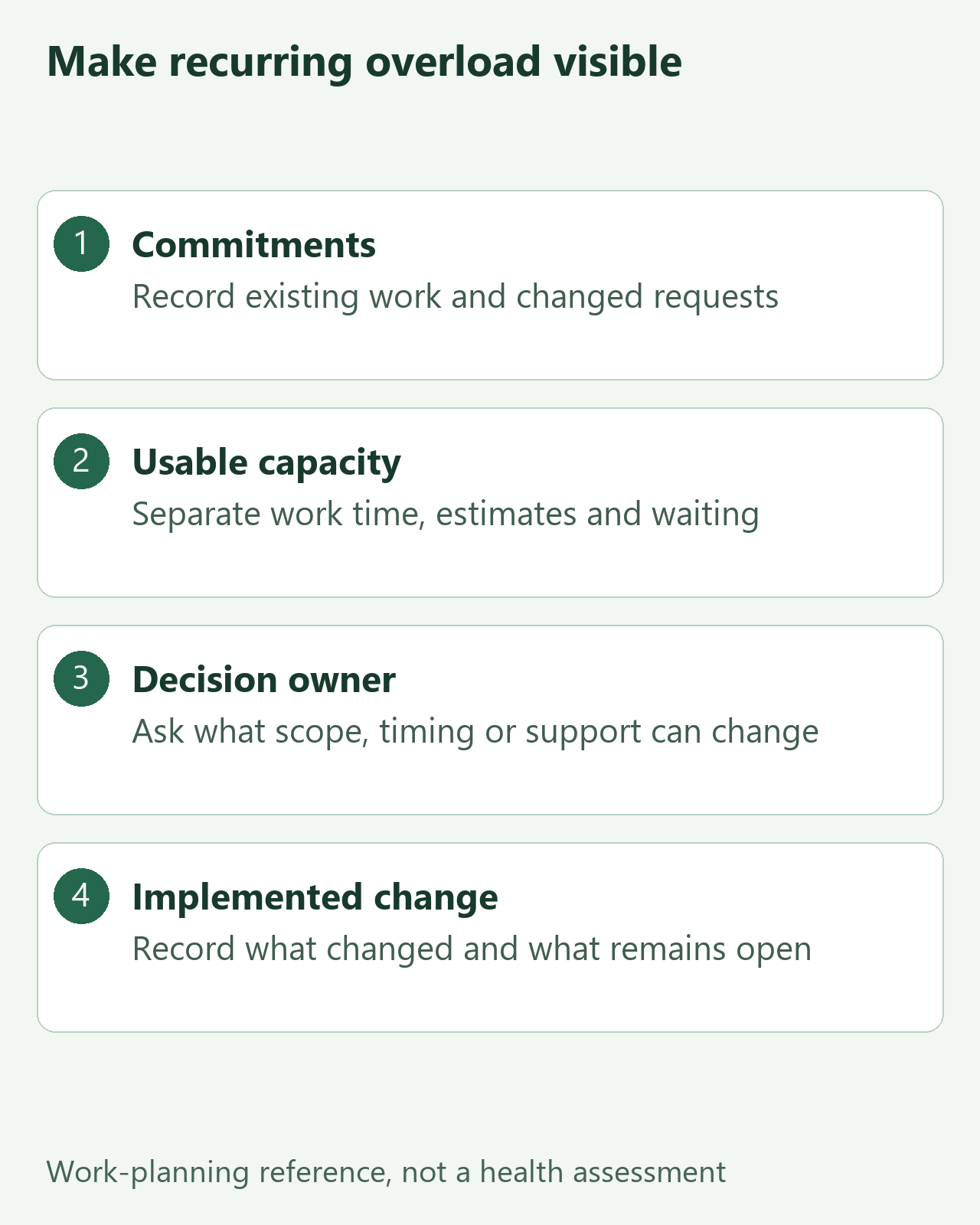
Examples to work through
These fictional work examples show how to identify the decision and its status.
Each urgent request leaves the earlier deadline in place
In this illustrative project example, a new customer request arrives while two agreed deliverables remain due. The worker records the new request and the earlier commitments, including their estimates and dependencies. The useful question is which scope or deadline can change and who can confirm it. Calling all three tasks urgent does not itself create the time or authority needed to complete them.
A service queue grows while staffing stays unchanged
A fictional service team observes new cases arriving faster than cases are closed during its staffed periods. The record separates case counts from case complexity and records coverage gaps. A manager needs to examine staffing, service expectations or routing. The example does not authorize workers to ignore required alerts or use one average handling time as a guarantee for every case.
An approval delay is mistaken for extra effort
An illustrative report needs a short editing task but cannot be released until an authorized reviewer approves it. The record shows editing effort and the elapsed approval delay separately. Its question concerns the missing decision and release date. Adding all the waiting hours to the worker’s effort estimate would hide the dependency rather than explain it.
The plan fits on paper but the required support is missing
A fictional worker’s tasks appear to fit the available hours, but they lack access to a necessary system and have no agreed cover for a required duty. The record names those missing resources. The next request concerns access, cover and the plan until they are available; it does not assume that faster work or a private coping practice can replace them.
Recurring workload observation record
Use this optional text record to separate confirmed work facts, proposals and unanswered questions. Save and share it through the appropriate process. Downloading it does not send your completed notes to this site, and it does not assess health or fitness.
Frequently asked questions
How long does overload have to last before I can raise it?
This guide sets no waiting period. Raise an immediate work, safety or health concern through the appropriate route when it arises. Dated observations can explain recurrence, but a certain number of days is not required before seeking support.
Does an overloaded plan prove that I have burnout?
No. It identifies a work-planning concern under stated assumptions. Burnout, other health conditions and personal symptoms cannot be assessed from a task total or this website’s score bands. Use appropriate professional support for health questions.
Should I record overtime as extra capacity?
Record what actually happened and what is agreed for the future separately. Do not assume that extra hours are authorized, sustainable or available for every planning period. Questions about hours, pay, safety or rights need the relevant workplace and qualified advice routes.
What if the decision owner does not resolve the gap?
Keep the remaining uncertainty explicit: which commitment cannot be confirmed, which decision is outstanding and who is responsible for responding. Use the appropriate support or escalation process. A more detailed private record cannot substitute for a decision or make an unsafe arrangement acceptable.
Choose the next reading task
Sources and what they support
- HSE: Management Standards — Demands
Workload, work patterns and achievable demands in relation to agreed working hours. UK work-design guidance; no clinical threshold or universal duration rule.
- HSE: Work-related stress — Overview
Work-design areas and early use of appropriate workplace or health support. UK context; local roles, procedures and rights vary.
- WHO: Burn-out an occupational phenomenon (2019)
ICD-11 classification and its occupational context. It does not validate website scores, exclude another health condition or establish individual fitness.
- WHO: Mental health at work (15 September 2026)
Organizational risks, work-directed support and adjustment examples. Return-to-work guidance concerns absences associated with mental-health conditions; no individual schedule, clinical clearance or local entitlement is inferred.
Work-planning information based on the listed sources. Local procedures and individual advice may be needed. The worksheet does not assess health, determine rights or provide individual clearance. No clinical reviewer is claimed for this article.