Low Control Over Priorities: Find the Decision Owner
Revised · Work-planning information
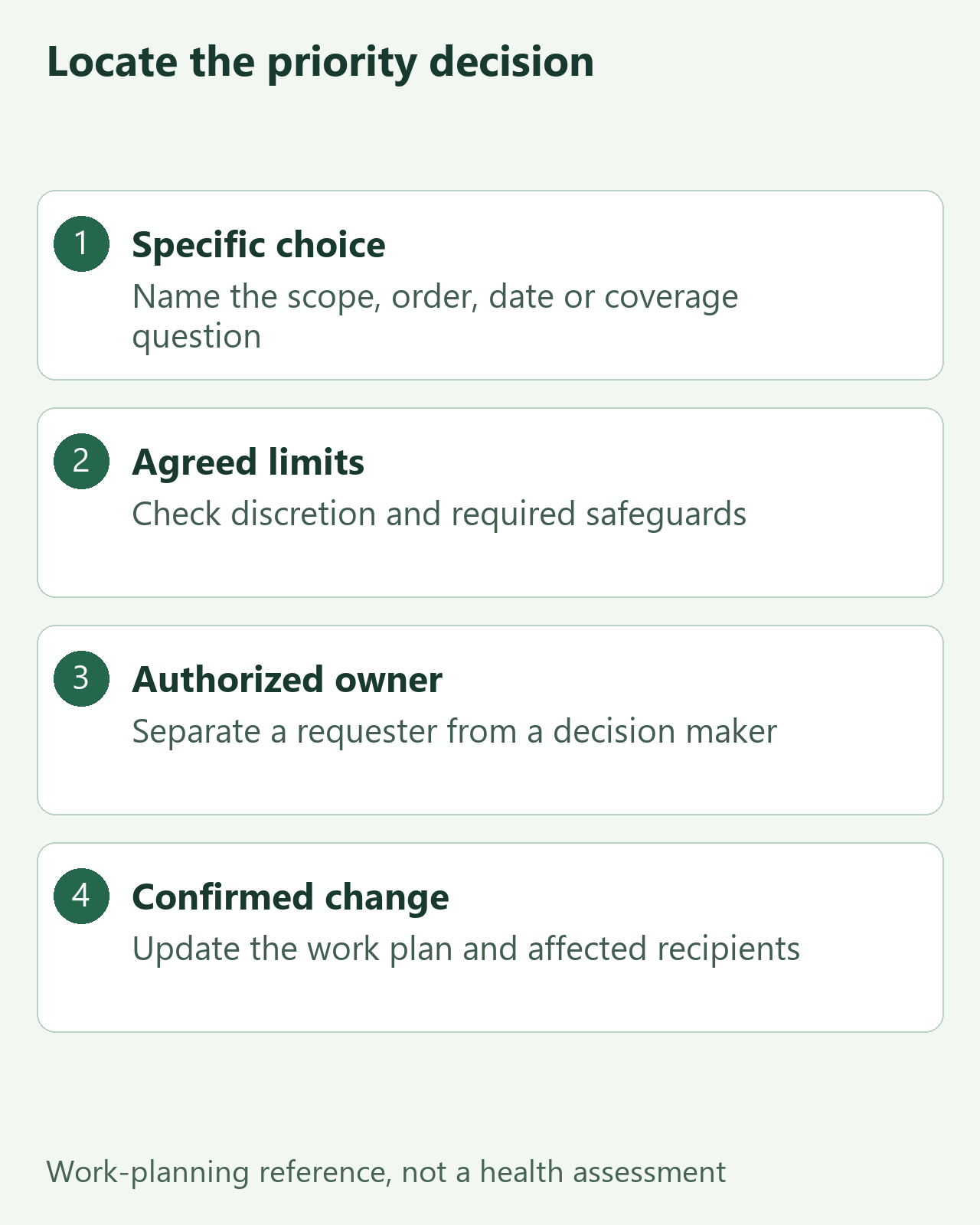
Being responsible for delivery does not necessarily give you authority to change scope, deadlines or coverage. Identify the particular decision you need, the limits already agreed and the person who can resolve the remaining question.
Ask what you can actually influence
Low control over priorities can appear when you are accountable for an outcome but have little say over the work order, scope, deadlines or changes that affect it. Start with the specific decision. ‘I have no control’ may describe an important experience, but it does not tell a requester which part of the work arrangement needs attention.
For example, you might choose how to carry out an approved analysis while being unable to change its delivery date. You might be allowed to reorder ordinary tasks but required to follow a safety procedure or staffed service standard. The useful question is which choice is available within the agreed arrangement and which needs someone else’s decision.
HSE’s Control standard describes how much say people have in the way they work. It includes pace where possible, using and developing skills, having a say about breaks and consultation over work patterns. Its wording does not promise control over every decision or authorize a worker to bypass required safeguards. Use it as a work-design reference, with its UK context intact.
Separate lack of control from too much work
A workload can fit the available time while its priorities keep changing without explanation. Conversely, a worker may have considerable freedom over task order but still face more work than the available time permits. Both concerns can occur together. Record each instead of assuming that greater personal efficiency will resolve a missing decision.
If the deadline, scope or staffing makes the plan unrealistic, use the workload record linked below. If two outcomes cannot both be achieved under the stated requirements, use the competing-demands guide. This page focuses on the authority to decide and how a proposed change becomes an agreed instruction.
Make a small decision map
On a narrow screen, scroll the table sideways to read all columns.
| Part of the work | What to check | Useful next question |
|---|---|---|
| Task order | Whether the order is your choice or already specified | Can I reorder these tasks within the agreed deadlines? |
| Scope | Who can approve a smaller or changed output | Which requirement can change, and who confirms it? |
| Deadline | Who owns the commitment and which recipients depend on it | Who can revise this date and update the affected people? |
| Method or pace | Required procedures and the discretion available within them | Which method or work-pattern choices are available here? |
| Coverage | Who can arrange staffing, cover or a handover | Who decides how this duty will be covered? |
| New requests | Who resolves a request that changes an earlier commitment | What changes in the current plan when this is added? |
Write ‘not yet confirmed’ when the authority is unclear. A job title, a colleague’s guess or the fact that someone made the request does not establish that they can change every affected commitment. HSE’s Role standard emphasizes clear, compatible requirements and routes for raising uncertainty or conflict; the actual decision structure still needs checking in your workplace.
Distinguish an available choice from a proposal
For each decision, keep three kinds of information separate: what is already agreed, what you are proposing and what remains unanswered. If your role gives you discretion over task order, you can work within that discretion. If a deadline change needs an owner’s approval, a draft schedule does not become an approved deadline because it is written neatly.
A useful note might say: ‘The approved output remains A by Thursday. B was requested later and is proposed for Friday, but no one has confirmed how it affects A. The unresolved decision is whether scope, timing or support changes.’ That describes the gap without guessing a motive or announcing a change you cannot authorize.
Do not frame mandatory safety, legal or service requirements as optional preferences. A clash involving such requirements needs the relevant authorized decision and advice routes. This page cannot determine which obligations apply or resolve a disputed instruction.
Bring the right people into the same decision
When several stakeholders affect the plan, separate their requested outcomes from the person or process that can reconcile them. Otherwise, you may receive two agreeable replies that still leave two incompatible commitments in place. Ask how the decision will be made and how everyone who depends on it will learn the result.
An illustrative message could be: ‘I have these two requests and these existing commitments. I can choose the working method, but I cannot confirm the revised scope and dates. Who should decide the priority, and can the resulting plan be confirmed to both requesters?’ Keep real details in the appropriate work channel and avoid unnecessary personal or confidential information.
If the requester cannot decide, ask who can. Record the outstanding question and any interim instruction actually given. Do not invent a fallback deadline or assume that silence approves your proposal. If the work has an immediate safety concern, use the appropriate immediate process rather than waiting for this conversation.
Check whether the decision changed the work
After a decision, note what changed, who confirmed it and which recipients were updated. Check whether the task system, schedule or coverage now reflects the agreement. A verbal intention to give you more control may leave the same requests and approval requirements in place.
Choose a review point suited to the decision, such as the next relevant planning meeting or the agreed check-in. This guide prescribes no one-week test. At the review, ask whether you could make the agreed choices, whether requests were routed as planned and whether unanswered decisions returned to the same worker.
Use support without having to prove a score
WHO identifies lack of control over job design or workload among workplace psychosocial risks. That describes a risk factor, not an assessment of your health or proof that low control explains every difficulty. Health concerns can be discussed with appropriate professional support alongside work-design questions.
HSE’s Support standard emphasizes knowing what support exists and how to access resources. If your decision map reveals no usable route, that is itself a question to raise through the appropriate workplace or representative channel. A website score is not required before seeking support, and this record does not decide local rights, benefits or an individual health situation.
Examples to work through
These fictional work examples show how to identify the decision and its status.
The method is flexible but the deadline is not
An illustrative analyst can choose the tool used for a report, while a delivery owner controls the deadline. The analyst records that distinction instead of treating freedom over the method as permission to change the date. The question becomes which scope, dependency or deadline the authorized owner can change, with the affected recipient informed of the decision.
Two requesters each assume their work comes first
In a fictional shared-service example, two teams ask the same worker to prioritize their requests. Neither requester confirms the effect on the other commitment. The worker lists both outcomes and asks for the agreed priority-setting route. The example does not assume that choosing the louder requester, or the one with the senior title, resolves the authority question.
A shift procedure leaves little individual discretion
An illustrative worker must maintain required coverage and follow a defined safety process. A proposed change concerns staffing and the work pattern around those requirements, not bypassing them. The record names the person who can consider coverage changes and the questions that still need an authorized answer. Personal preference does not turn a required safeguard into an optional task.
A proposed priority is mistaken for an approved one
A fictional project worker drafts a reordered task list after a discussion. The owner has acknowledged the note but has not confirmed the changed dates. The worker marks the dates as proposed and asks for the remaining decision. Acknowledgement, receipt and approval are different events; the record should show which actually occurred.
Priority authority and decision record
Use this optional text record to separate confirmed work facts, proposals and unanswered questions. Save and share it through the appropriate process. Downloading it does not send your completed notes to this site, and it does not assess health or fitness.
Frequently asked questions
Is low control the same as poor time management?
No. Time-management choices may be available within an agreed role, but they do not automatically provide authority over scope, deadlines, staffing or competing commitments. Identify the actual decision and the discretion available before choosing a response.
Does the person making a request own the priority decision?
Not necessarily. They may control their desired output without being able to revise another commitment or arrange support. Check the actual decision route and who must confirm the resulting change.
Should I ask for every work choice in writing?
Use the record and communication practice appropriate to your role and workplace. The aim is to distinguish an agreed choice from an unanswered proposal, especially where other people depend on the result. This page does not impose a universal documentation rule or decide a legal requirement.
What if the decision route is unclear or unavailable?
Record the specific unresolved question and seek the appropriate workplace, representative or qualified advice route. Do not treat uncertainty as permission to bypass a required safeguard or as a reason to delay necessary health or safety support.
Choose the next reading task
Sources and what they support
- HSE: Management Standards — Control
Influence over how work is done, where possible, and consultation about work patterns. It does not authorize bypassing required safeguards or another person’s decision.
- HSE: Management Standards — Role
Clear responsibilities, compatible requirements and ways to raise uncertainty or conflicts. It does not decide which individual request has priority.
- HSE: Management Standards — Support
Usable organizational support, resources and constructive feedback. It does not guarantee that a proposal will be approved.
- WHO: Mental health at work (15 September 2026)
Organizational risks, work-directed support and adjustment examples. Return-to-work guidance concerns absences associated with mental-health conditions; no individual schedule, clinical clearance or local entitlement is inferred.
Work-planning information based on the listed sources. Local procedures and individual advice may be needed. The worksheet does not assess health, determine rights or provide individual clearance. No clinical reviewer is claimed for this article.