Practical guide
Work Boundary Examples for Response Times and Notifications
Five fictional work situations show how to agree response windows, preserve required alerts and urgent coverage, and keep proposals separate from confirmed rules. Includes negotiation wording, two tables, an original diagram and an editable agreement.
A useful boundary tells people what will happen next
A work response boundary needs a work window, a monitored route, an ordinary response expectation and a confirmed exception route. “I will check messages less often” leaves everyone guessing. “Send ordinary project requests to the shared board; I review it at the agreed work windows, confirm receipt and give a next update” gives the team something it can check.
Start with your actual duties. A project writer, a staffed service desk and the person currently on call cannot use the same notification rule. Required checks, customer commitments, safety procedures and approved escalation routes remain relevant. A preference written in a status message does not change those responsibilities.
The five examples below are fictional negotiation drafts, not recommended response-time benchmarks. Their hours and channels illustrate decisions a team must make. Replace them with your real working pattern and requirements, and distinguish a proposal from an arrangement that the people responsible have confirmed.
This page concerns recurring working availability. For a specifically dated absence, use the before-leave handover; a permanent response rule does not establish temporary cover for a holiday or leave period.
Separate monitoring, acknowledgement and resolution
A message can arrive while nobody assigned to that channel is working. It can be noticed without its task being completed. Separate these events before agreeing a response time. Otherwise, “reply within a day” can mean five different things to five people.
| Event | What to specify | What it does not establish |
|---|---|---|
| Arrival | Where the request is submitted and whether that route is staffed. | A person has read or accepted the request. |
| Review | Which work window or coverage period includes a channel check. | Every incoming task can be resolved during that check. |
| Acknowledgement | Who confirms receipt, and which clock or deadline applies. | The work is approved, accepted as feasible or finished. |
| Next update | When the sender will receive a status, question or revised estimate. | The update will contain a completed solution. |
| Resolution | Scope, information, dependencies, authority and an agreed delivery expectation. | A quick acknowledgement guarantees a quick result. |
A clearer acknowledgement might be: “I have received the request. I need the approved brief before estimating delivery; I will update you at our next agreed review.” It confirms receipt and the next communication without pretending the dependency has been resolved.
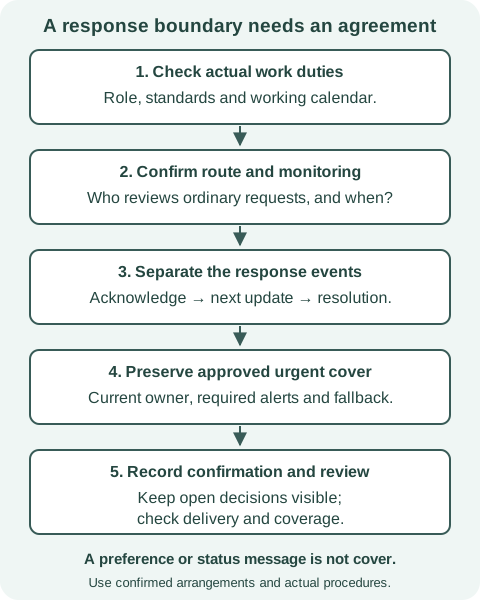
Example 1: a writer or analyst needs uninterrupted project time
Fictional setting: Morgan works on a report during a 09:00–17:00 work window. Requests currently arrive through email, chat and comments on an old draft. A team proposes reviewing ordinary requests at 10:00 and 15:00. Those times are negotiable examples, not evidence that two checks are enough for every job.
Proposed wording: “Could we put ordinary changes on the current project board and use the 10:00 and 15:00 reviews to confirm receipt and discuss delivery? If a decision cannot wait until the next review, could the project owner use our agreed urgent route and identify the consequence of waiting?”
Before changing notifications, Morgan asks who monitors the urgent route, whether the project owner can use it, and what happens if that person is unavailable. The team also decides how a request arriving after the last review is handled. “We will discuss that tomorrow” needs the actual next working window, particularly around non-working days.
After confirmation: Morgan can reduce ordinary chat alerts in the agreed focus period while retaining the required urgent route. The board records each request once, its state and the next update. A request that needs three hours of analysis does not acquire a same-review completion promise merely because it was acknowledged.
Watch for: a client commitment that conflicts with the proposed reviews. That needs an authorised timing, scope or coverage decision, not a quietly changed status message.
Example 2: a service desk needs coverage through a shift
Fictional setting: Priya works a staffed service queue. The organisation already has response standards and a procedure for priority incidents. She cannot replace those standards with the project writer’s review windows.
Proposed wording: “During my assigned queue period, I will follow our response standards. Can we confirm who covers the queue during the scheduled break and who accepts unresolved items at shift handoff? I also need to know which channel carries priority incidents so routine duplicate messages do not compete with it.”
The supervisor confirms the actual coverage window, acceptance of the handoff and a fallback if the next person is unavailable. A colleague’s name on a draft rota does not show that the colleague is available, equipped or assigned to cover. The worker needs the relevant system access and instructions as well as a contact name.
Notification decision: retain the required queue and incident alerts during the assigned period. Consolidate optional duplicate messages only after the team has checked that the change does not hide a required request. Scheduled breaks and off-duty arrangements follow the actual procedures and confirmed coverage.
Watch for: a recurring queue gap. Repeatedly checking the inbox during every break may conceal a staffing problem. Bring the observed gap to the responsible supervisor, including what remains uncovered and when; an individual notification setting cannot supply another staffed person.
Example 3: an on-call role needs a reliable alert route
Fictional setting: Luis has an assigned on-call period and ordinary project work outside it. The team has an incident procedure, an alerting system and a backup escalation route. Those arrangements determine the required response, rather than the word “urgent” appearing in a casual message.
Proposed wording: “While I am assigned on call, I will retain our required alert route and follow the incident procedure. Could ordinary project requests stay on the project board? Outside my assigned period, could incident reports go to the current rota owner and its backup, rather than rely on a direct message to me?”
Confirm the rota dates and time zone, the receiving device or system, required checks, who owns escalation and what the approved fallback does. Check conflicts with focus periods, other assignments and planned absence. If the route is unreliable, report that failure through the actual procedure; do not describe a silent device as a successful boundary.
Notification decision: change optional ordinary-message alerts separately from required incident alerts. A device-level quiet setting may affect more than one channel. Verify that the approved alert arrangement still works before relying on the new configuration.
Watch for: routine work repeatedly reclassified as an incident, or an incident route that no one actually monitors. Both require an operational decision. This example neither authorises ignoring a real alert nor assumes unlimited personal availability solves missing cover.
Example 4: collaborators work different days or time zones
Fictional setting: Ana and Sam have different working calendars. Ana posts a request on Friday in her own local time. Sam’s next scheduled review is on Monday in Sam’s working calendar. “Tomorrow morning” and “within one day” would be ambiguous descriptions.
Proposed wording: “For ordinary requests, can we name the recipient’s next scheduled review window and state the relevant calendar date and time zone? I will confirm receipt at that review and give a next update. If you need an earlier decision, please state the actual deadline so we can check available cover.”
Write the actual date, named zone and expected event in the agreement. Confirm whether the rule uses elapsed hours or scheduled working time; weekends, local non-working days and shift patterns can make the two very different. Do not infer a conversion from someone’s city without checking the date and their actual schedule.
Sender decision: mark whether a message is for the next work window, give the required outcome and deadline, and use the confirmed urgent route when applicable. Scheduled sending can reduce avoidable interruptions, but it does not solve a missing deadline decision or provide cover by itself.
Watch for: a meeting or external commitment before the recipient’s next review. Ask the authorised owner whether to change timing, arrange cover or change the work. A calendar mismatch should be visible before it becomes a missed promise.
Example 5: a team manager needs a shared rule people can trust
Fictional setting: A manager sends occasional evening messages, writes “no rush,” and then asks why the work was not finished first thing. Team members cannot infer a reliable expectation from the label alone.
Proposed wording: “Let us agree what an ordinary evening message means: it is for the next scheduled work review unless we explicitly use our urgent procedure. At that review, we will acknowledge it and agree feasible delivery. I will include the needed outcome and deadline, and we will decide who covers genuinely time-sensitive work.”
The manager checks the proposed rule against customer commitments and duties, consults the affected workers and resolves conflicting demands. They record how someone can raise an exception without having to monitor every channel continuously. A team agreement should specify who can revise it and where the current version lives.
Management practice: demonstrate the rule. Avoid treating a voluntary quick reply from one person as the new minimum for everyone. When a request misses the agreed route, redirect it consistently and investigate a repeated mismatch rather than reward hidden extra availability.
Watch for: a policy that says one thing while performance conversations demand another. Bring the contradiction into the review with dated work examples. Clear wording matters, but it needs compatible expectations and usable resources behind it.
Choose notification settings after agreeing who monitors what
A notification is a signal that something has arrived, not proof that a response is required from you at that moment. Choose settings around the confirmed work arrangement. Check device-wide modes as well as individual channels; muting a routine conversation should not accidentally suppress a required incident route.
| Route | Question before changing alerts | Arrangement to record |
|---|---|---|
| Ordinary project requests | Where is the current request, and when is it reviewed? | One approved route, review windows and next-update expectation. |
| Staffed incoming queue | Who monitors it during each assigned period? | Actual response standards, coverage and accepted shift handoff. |
| Required incident alerts | Which procedure and backup apply? | Approved alert path and required checks; verify the settings preserve it. |
| Duplicate optional messages | Can they point to the existing work record? | Team-confirmed consolidation, without hiding required work. |
Use a simple trial only when it fits the actual duties: ask whether expected messages reached the right person, whether ordinary requests received the agreed update, and whether any required alert was missed. Review the workflow rather than count fewer notifications as automatic success.
Keep a proposed boundary separate from a confirmed rule
Copy the record below and fill in one recurring work arrangement. If coverage, a deadline or authority is unknown, retain the open question and identify who can decide it. Do not convert an unanswered message into agreement by updating your status.
A confirmed record can still need revision. Date it, keep the current version accessible to the people using it, and make the change visible when the rota, role or response standard changes.
RECURRING WORK RESPONSE AGREEMENT — DRAFT
Role and actual work pattern:
Working dates / named time zone / coverage windows:
Ordinary request route and current record location:
Who monitors the route, and when:
Acknowledgement expectation and clock definition:
Next-update expectation:
How resolution, dependencies and delivery are agreed:
Required standards and duties retained:
Locally defined urgent conditions and approved route:
Current urgent owner / coverage / authorised fallback:
Notification change proposed and required alerts retained:
People who must confirm the arrangement:
Proposal / confirmed / disputed / still unknown:
Confirmation date, version and unresolved decision:
Review date and who can revise the rule:
Silence is not confirmation; a status message is not cover.
Download the five examples and blank response agreement (TXT). It is editable plain text; keep private client, personnel and medical details out of a broadly shared working record.
Three ways to ask without promising a unilateral change
When the other person says everything needs an immediate answer
“I can acknowledge arrivals, but I cannot complete every task immediately. Which requests need a decision before the next review, and who can decide what work moves when they arrive?” This asks for priority and authority rather than treating the label “urgent” as unlimited capacity.
When a client wants an earlier response than you can provide
“The current arrangement gives an acknowledgement at the next agreed work window. Your new deadline is earlier. I need to check whether we can arrange cover or change delivery; I have not confirmed the new timing.” Do not replace a real client commitment without the authority to renegotiate it.
When your proposal receives no reply
“The review-window proposal is still unconfirmed. The unresolved points are queue cover and the urgent route. Who can confirm those, and by which decision date?” Keep the actual existing duties in view while seeking the decision. If expectations conflict or remain unworkable, use the relevant manager, workplace representative or support route rather than quietly assume your preferred rule is now policy.
Review delivery and coverage, not a burnout score
At an agreed review, compare a small set of actual requests with the rule: where each arrived, when it was reviewed, whether receipt was acknowledged, what next update was given, and who owned an unresolved dependency. A late solution can arise from missing information even when the acknowledgement was on time.
Record exceptions without changing the definition of the whole rule after each one. If a customer requirement, role change or staffing gap makes the arrangement incompatible with the job, bring that conflict to the person who can change work design, coverage or commitments. Use the workload-priority conversation when additional monitoring consumes capacity needed for other tasks.
Fewer alerts alone do not show that work is covered, recovery is restored or burnout is resolved. The useful outcome is a clearer, feasible arrangement with genuine exceptions and open decisions visible.
What the sources support, and where the examples stop
HSE’s Management Standards discuss achievable demands in agreed work hours, influence over work patterns where possible, clear and compatible roles, and support that people know how and when to access. These principles support discussing response expectations as work design. HSE does not prescribe the schedules, scripts or notification settings in these fictional examples.
The HSE overview includes UK legal and occupational-health context. This page does not extend its legal statements into a universal right to disconnect or determine an individual employment entitlement. Your actual procedures, contracts, representation and qualified local advice matter when rights or formal disputes are involved.
WHO classifies burnout as an occupational phenomenon, not a medical condition, and limits the term to the occupational context. A response agreement is neither a diagnostic test nor a treatment. If distress is persistent, severe or affecting health or daily functioning, seek appropriate professional or workplace support without waiting for a perfect communication rule.
For the practical steps of proposing and implementing one arrangement, use set an availability boundary. For the conditions behind messages that feel continuously demanding, use always-on communication. These examples help make the next work conversation specific; they do not guarantee agreement or a health outcome.
Sources and further reading
- HSE Management Standards: DemandsAchievable demands in agreed hours; no universal response-time benchmark.
- HSE: Work-related stress—overviewWork-design areas and appropriate support routes; UK legal statements are not generalised.
- WHO (2019): Burn-out as an occupational phenomenonOccupational classification and scope; no diagnosis, treatment or recovery guarantee.
- HSE Management Standards: ControlInfluence over work patterns and pace where possible; no unilateral power to waive duties.
- HSE Management Standards: SupportUsable support and knowing how and when to access it; fictional coverage must be confirmed.
- HSE Management Standards: RoleClear compatible roles and local routes for uncertainty; no authority inferred from an unanswered draft.
When interruptions still prevent a task from finishing
Distinguish original-task effort, other work and waiting. Link duplicate notifications to the same request, then take the unresolved routing or coverage question to the person who can decide it.
Build an interrupted-task timeline