Practical guide
How to Ask for Work Stress Risk Assessment Results
Ask for the assessment findings, controls and action status relevant to your work. Distinguish results from survey scores and private records, with original request wording and a fictional response.
On this page
Ask for the findings that relate to your work
Ask for the work-stress assessment findings that cover your work, what risks were identified, and what the employer decided to do. A useful response identifies the affected work, controls, action owners and what remains unresolved. It should help you understand the work risk and the response, not merely provide an unexplained score.
HSE’s current employee guidance says employers have a legal duty to assess stress risk and share the assessment results. Its risk-assessment guidance also says employers should act on the assessment. This is a Great Britain reference; it does not decide your rights in another jurisdiction or provide a legal finding about your employer.
You can raise a concern even if you do not yet know whether an assessment exists. Explain the concrete condition you need addressed, then ask which assessment or process covers it. Requesting a document is one way to clarify the response; it is not a requirement to complete before seeking appropriate support.
Distinguish an assessment result from other records
On a small screen, swipe inside the table, or focus it and use the arrow keys.
| Record | Question it helps answer | Do not assume |
|---|---|---|
| Assessment findings and decided controls | What work risk was identified and what response was selected? | That every action is implemented or every work group was covered. |
| Survey summary | What did the participating group report, within the response limits? | That a score alone identifies the cause or includes every worker. |
| Action plan or register | Who approves and delivers each change, and what is its current status? | That a proposed or approved change has happened. |
| Raw identifiable responses or health records | Contains individual information that may have a different handling process. | That sharing assessment results means unrestricted access to all private records. |
| Review record | What was implemented and what was observed afterwards? | That one improvement proves a lasting or clinical effect. |
The table explains purposes, not a universal disclosure rule. Ask the responsible person what results can be shared through the appropriate process. An account of hazards and controls can be useful without a colleague’s medical history or their identifiable questionnaire response.
For team-level analysis, use the survey-and-evidence guide. This page focuses on obtaining and understanding an assessment response that applies to your work.
Write a precise request with a usable scope
Name the work group or task and the condition you are asking about. Then request the findings, decided controls and current action or review status that apply to it. If the assessment covers a wider organisation, ask how your working arrangement was included rather than demanding unrelated individual files.
Original request wording: “Could you share or explain the work-stress assessment results relevant to our morning queue and follow-up duties? I would like to understand the work conditions assessed, the identified risks, decided controls, the responsible action owners and the current implementation or review status. Please explain any part of that work or shift that is not covered and how we can raise it.”
Add a practical format question: where the results are available, which version is current, and who can explain an unclear finding. If notes will be discussed, ask how the process handles information. Do not assume that a shared document gives every worker access to raw health or survey records.
If your manager is part of the concern, check the actual alternative procedure with an appropriate representative or HR contact where available. HSE’s employee leaflet encourages participation and two-way consultation; being heard is not a guarantee that a preferred change will be approved.
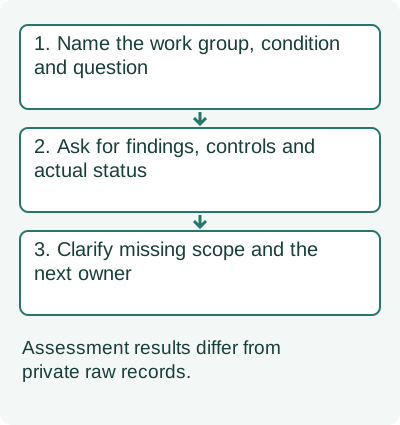
Read a fictional response without assuming completion
Fictional example: a worker asks about competing queue and follow-up demands. The employer provides a summary naming the morning duties, an unresolved coverage risk, and a proposed rota change. It lists an approval owner and says cover is awaiting a compatible plan for the helper’s other duty.
The summary answers what was assessed and which response is proposed. It does not establish that cover is available. A useful follow-up is: “Who will confirm the compatible arrangement, and how will we know when it is implemented?” Record the answer as a decision, proposal or remaining question according to what was actually said.
The worker then notices that late-shift follow-up was outside the assessment scope. That is a specific coverage question, not proof that every finding is invalid. Ask whether that work has its own assessment or how the missing condition will be considered. Preserve the scope gap in the record.
Finally, the employer shares a survey summary but no findings or controls. A survey can inform assessment; it is not by itself an explanation of the identified risk and response. Ask what assessment conclusion was drawn and what work actions followed, without trying to infer a diagnosis from the score.
The action-plan guide helps distinguish proposal, approval and implementation. Download the original request-and-response record (TXT) to keep your actual unanswered questions together.
Clarify missing coverage or an unwritten assessment
HSE’s current guidance distinguishes assessing and acting from the requirement to write the assessment down. It says an employer with fewer than five workers does not have to write anything down, but still assesses and acts; keeping a record is useful for later review. With five or more workers, the assessment must be written down in this Great Britain context.
Do not confuse that writing threshold with the conditions HSE uses to consider investigating an organisational stress concern. Nor does it define an anonymous survey group size, a personal support threshold or entitlement to all raw information.
For an unwritten assessment, ask the employer to explain the relevant risks, decisions and next steps. For a missing work group or changed arrangement, ask how that condition will be assessed and addressed. “No document supplied” and “no assessment undertaken” are different claims; retain what is known rather than assuming the second from the first.
HSE says assessment paperwork should help communicate and manage risks. A large file with no clear current response may be less useful than an understandable account of significant risks and decisions. If the response remains unclear, raise the specific gap through the actual workplace procedure or seek qualified local advice for a rights question.
Check what the result does and does not establish
These fictional checks separate findings, private information and the stage of an action.
Case 1
The employer shares a staff survey score. Does that alone explain the assessed work risks and controls?
Show answer and explanation for case 1
No. Ask which findings and work decisions followed from the evidence.
The survey is an input with scope and response limits. The requested assessment response should explain the relevant risk and the action, not turn a score into a clinical conclusion.
Case 2
The organisation has four workers and no written assessment. Does HSE’s writing exception remove its duty to assess and act?
Show answer and explanation for case 2
No. The exception concerns writing the assessment down.
The current Great Britain guidance still requires assessment and action. Ask for an explanation of the relevant risks and response; do not automatically claim that lack of a document proves no assessment occurred.
Case 3
A summary says a cover rota is approved. Can the worker record that the risk has been controlled?
Show answer and explanation for case 3
Approval alone is insufficient evidence of implementation.
Ask whether the cover actually operates and how its work consequences are reviewed. The results request does not itself certify compliance or establish a personal health outcome.
Sources and further reading
- HSE: Help for employees on stress at workCurrent employee guidance on assessment and sharing results, with alternative workplace and support routes. Great Britain context.
- HSE: Stress risk assessmentCurrent duty to assess and act, written-assessment threshold, and the role of paperwork in communicating and managing significant risks.
- HSE: Working together to reduce stress at work (INDG424, November 2008)November 2008 employee guide on participation, two-way consultation and actual concern/support procedures. Used for that process guidance.