Practical guide
Reporting Work-Related Stress to HSE: What to Check
Check HSE’s organisational stress criteria, the correct authority and the current reporting service. Includes a fictional concern summary, privacy limits and an original preparation record.
On this page
Check HSE’s specific work-stress criteria
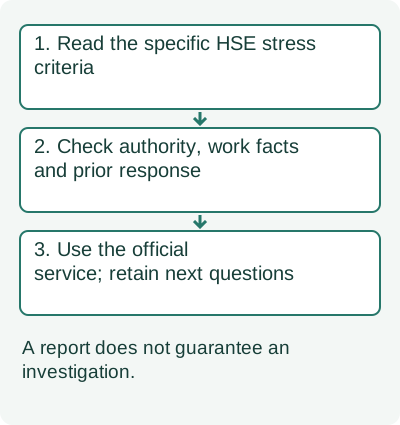
Before reporting work-related stress to HSE, read its specific criteria rather than assuming every individual workplace problem falls within its investigation role. HSE says it considers concerns involving wider organisational failings and several employees currently experiencing work-related stress or related ill health, where the Health and Safety at Work etc Act 1974 can apply.
HSE generally does not investigate individual stress cases. Its published criteria also exclude concerns that have not already been raised with the employer with sufficient time for a response, and matters better addressed through more specific legislation or another authority. The source gives no fixed number of affected workers or universal employer waiting period.
These are HSE’s investigation boundaries in Great Britain, not a test of whether an individual deserves support. Do not wait for colleagues, a questionnaire score or a completed evidence file before seeking appropriate help for your own concern. HSE states that operational priorities mean it cannot respond to every report.
Choose the right route for the actual issue
On a small screen, swipe inside the table, or focus it and use the arrow keys.
| Issue or purpose | Check this route | Do not assume |
|---|---|---|
| Personal health or support need | Appropriate health/support professional or available workplace support. | HSE investigation is a personal treatment service. |
| Work task, resource or priority decision | Actual manager or work owner; alternative procedure if involved. | A website score grants authority to change duties. |
| Unacceptable behaviour or grievance | Actual employer policy, representative or qualified advice. | HSE is the primary investigator of every bullying complaint. |
| Potential organisational work-stress failing | HSE’s stress criteria and correct enforcing authority. | Several concerns automatically produce an investigation. |
| Immediate danger or potentially criminal violence | Applicable emergency, safety or police route for the situation. | An online regulatory report is an immediate emergency response. |
HSE’s stress page points bullying and harassment concerns toward appropriate employer and advice routes; it distinguishes equality and potentially criminal issues. This guide does not decide a legal classification, guarantee representation or claim that Acas investigates a particular complaint.
The current HSE reporting service covers workplace or public-space health and safety issues in England, Scotland and Wales. Some issues belong with a local authority or another enforcing authority. Follow the official “check if this service is right for you” guidance before choosing the recipient.
Prepare work facts and the employer response
Prepare a short account of the work condition, where it occurs, who may be at risk and what supports that account. Distinguish direct observation, another person’s account and an inference. Do not invent colleagues’ diagnoses or describe a whole organisation as affected when your evidence concerns one shift.
For the organisational stress question, describe the possible wider failing and the scope of currently affected work. Keep the employer concern and response visible: what was raised, when, to whom, what they said or did, and what remains unresolved. If time or wording is approximate, label it. The record is preparation, not proof that HSE will accept the case.
HSE’s current service asks about location, sector, the issue, duration, people at risk and available evidence, as well as how you relate to it and what response you want. It also asks about potential dangers to inspectors. Supply actual information through the permitted process; do not obtain restricted records or manufacture supporting photographs.
Use the factual event-report guide for separating recollection and evidence. Its internal-report record does not establish that the HSE organisational stress criteria are met.
Understand the reporting service and information sharing
Use the official reporting-service link in the sources below for current instructions. This website does not submit a report or collect your concern. HSE asks for name and contact information to identify the person, seek further information and explain if the matter is outside its responsibility. If contact details are missing and the report is insufficient, it may be unable to act.
The current service says it does not share the reporter’s personal details with the business or organisation. It may share the details of the issue when following it up, and the business may work out who reported it. The service also explains information sharing with people managing the issue and law-enforcement authorities where required. Do not call this guaranteed anonymity.
After a report, HSE says it may contact you for further information within three working days and aims to email an outcome within fifteen working days. These are current service descriptions, not a guaranteed investigation, a deadline imposed on your employer or permission to postpone urgent support.
The service links to guidance about possible whistleblower protection. It does not establish that every reporter is protected in every circumstance. Use the linked official guidance and qualified local advice for an individual rights question; this article does not decide it.
Source: [2]
Use a fictional concern summary with clear limits
Fictional example: a representative has direct work records showing that two required duties overlap on several shifts. Several workers have described current work pressure, but the representative has no clinical records. A concern was raised with the employer, and the reply promised to review cover without confirming an actual change.
A traceable original summary is: “The concern is the unresolved coverage arrangement for the queue and required follow-up duties across the identified shifts. The attached permitted work references show the overlap. Worker accounts describe current work pressure; I cannot verify a diagnosis. We raised the arrangement on [actual date] with [actual recipient]. The reply was [accurate account]. Cover remains unconfirmed at the time of this record. We are asking whether this concern falls within the appropriate authority’s remit.”
This summary identifies an organisational question and evidence limits. It does not establish statutory applicability, sufficient employer response time or that HSE will investigate. If the real evidence concerns only one person, retain that limitation and seek the appropriate individual or workplace route.
Download the original report-preparation record (TXT). Keep contact details and evidence in your own appropriate records. Read the live official service before sending anything, and retain the submitted version and actual acknowledgement.
Check what acknowledgement and follow-up mean
These fictional checks concern HSE’s stated scope, the service and the limits of a report.
Case 1
The employer has five workers. Does that automatically meet HSE’s stress-investigation criteria?
Show answer and explanation for case 1
No. The written-assessment threshold and investigation criteria are different.
HSE’s stress page refers to several currently affected employees, wider organisational failings and applicable legal scope. It does not give a fixed five-complainant rule.
Case 2
HSE says it does not share personal details with the employer. Can a report promise that nobody will identify the reporter?
Show answer and explanation for case 2
No. The organisation may infer who reported the issue.
The current service distinguishes personal contact information from the issue details it may share, and explicitly warns that identity may be guessed.
Case 3
The service acknowledges a report. Does that mean HSE has approved the account and will investigate?
Show answer and explanation for case 3
No. Retain acknowledgement as acknowledgement.
HSE may seek further information, decide the matter is outside its role or apply operational priorities. Its timing aims do not guarantee a particular action or outcome.
Sources and further reading
- HSE: Reporting a work-related stress concernCurrent organisational stress-investigation criteria and limits, including prior employer concerns, legal scope and other-authority issues.
- HSE: Tell us about a health and safety issueCurrent England/Scotland/Wales reporting-service information, requested details, information sharing, identity-inference caveat and stated follow-up aims. Use the live official service for current instructions.
- HSE: Help for employees on stress at workCurrent employee advice on raising concerns and finding appropriate available support. Individual support does not depend on regulatory investigation.