Practical guide
How to Use the HSE Stress Talking Toolkit
Choose the relevant paired toolkit sheets, listen to the work problem, and turn proposals into owned actions within wider risk management. Includes a fictional worked example and original record.
On this page
Choose a toolkit conversation for the actual work problem
Use the HSE Stress Talking Toolkit to discuss a specific work condition, then connect the proposed response to someone who can act. Each of its six themes has a question sheet and a second sheet of ideas for tackling causes. You can start with the relevant theme; completing all six is not a condition for taking action or seeking support.
The general toolkit is a November 2021 HSE publication, still linked from its current toolkit page. It addresses work-related stress in Great Britain. It does not diagnose burnout, score a person’s health or certify that an employer has managed every risk. HSE also provides sector versions; this guide covers the general version.
On a small screen, swipe inside the table, or focus it and use the arrow keys.
| Theme | Work question to bring | Keep distinct |
|---|---|---|
| Demands | Can the required work fit the actual hours, skills and working conditions? | A packed schedule is a work question, not a diagnosis. |
| Control | Which choices about pace, methods or work patterns can the worker influence? | Responsibility is not unlimited decision authority. |
| Support | What information, resources or help is usable when needed? | An offer is not proof that support is available. |
| Relationships | Which behaviour or working relationship needs an appropriate response? | A group conversation does not replace a serious reporting route. |
| Role | Are responsibilities understood and compatible? | Clarifying a duty differs from approving conflicting requirements. |
| Change | What information, consultation or support is needed during a change? | Being consulted is not a guarantee of a preferred outcome. |
These are original selection prompts, not copied HSE form questions. Where the problem crosses themes, retain the connection. A late handover may involve demands, support and unclear roles; the labels should help identify decisions rather than divide one problem into six unrelated meetings.
Use the question sheet before the action ideas
Open the official general toolkit using the source link below. Read the relevant pair together: the first sheet starts discussion; the second offers possible ways to tackle the causes. In the demands pair, for example, questions concern achievable workload, deadlines and training, followed by ideas about work patterns, workload and the environment.
Let the worker describe what happens before selecting a solution. Ask which required task, timing or resource makes the arrangement difficult. Check the account back: “Have I understood which work is interrupted and what remains unfinished?” Do not use an idea sheet as a list of changes that every employee automatically receives.
HSE sets no strict conversation format or frequency. A conversation can fit an existing one-to-one, training session or a separate meeting, and can cover one theme or more. Make actual time available and explain the purpose and handling of the notes. The toolkit is not permission to demand private medical details in a group.
Source: [1]
For a discussion involving several workers, use the work-condition discussion guide to plan participation and feedback. The named tool helps start the conversation; those practical arrangements still need an appropriate local process.
Turn a discussion into an owned work decision
Separate the observed condition, proposed response and actual decision. “We should provide cover” is a proposal. It becomes a usable arrangement only when the responsible person approves the necessary change and somebody can deliver it during the relevant work window.
Record the intended change, approval owner, delivery owner, dependency and next check. If the person running the discussion lacks authority, identify who receives the unresolved decision. Do not silently turn a facilitator’s notes into a commitment from another team.
Choose a review point that fits the work and the action. HSE’s sheets include space to revisit proposed changes, but do not prescribe a universal seven-day trial. Check whether the arrangement actually operated before judging its consequences. Keep urgent work or personal support needs on their appropriate route while the plan continues.
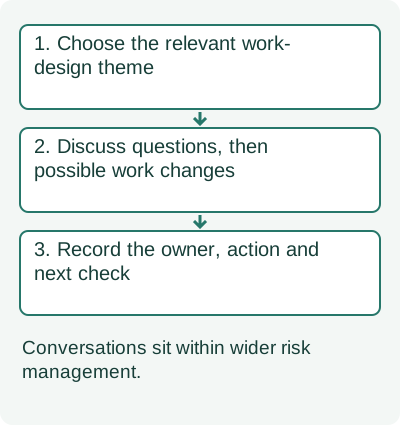
The action register provides the fuller implementation record. A conversation can identify an issue; the organisation still needs to manage the risk and communicate what was decided.
Follow one fictional demands-and-support example
Fictional example: a coordinator must complete follow-up calls during a morning period but also receives the shared queue. They can identify the interrupted work; they cannot approve a rota change. The manager begins with demands and asks how the required tasks overlap, then checks support: what cover is actually available?
A first proposal is “ask a colleague to cover.” The colleague has a separate required duty at the same time. That dependency means the cover is not confirmed. The manager sends the competing-duty decision to the work owner rather than describing the worker as resistant to help.
In the next fictional step, the work owner confirms a compatible priority arrangement and the shift lead assigns the cover. The record now distinguishes approval from delivery. At the relevant morning window, the review asks whether the queue was covered, follow-up proceeded and the helper’s own work remained manageable.
If the helper is reassigned and cover never happens, record missing implementation. If cover happens but another required task is displaced, retain that new work issue. Neither result proves a clinical effect or a reduction in someone’s burnout.
Download the original conversation follow-up record (TXT). Fill it with actual work facts in your own copy. It is an independent educational record, not an HSE form or a completed employer risk assessment.
Fit the tool into wider risk management
HSE explicitly says the toolkit should not be used in isolation as the employer’s only response. Connect what is learned to the assessment of work risks, employee participation, action and continued review. A manager can feed concerns to the relevant decision owner; a meeting alone does not establish that the risk was controlled.
Tell participants which actions are agreed, which remain proposed and where they can raise a missing perspective or new concern. An arrangement may look available in a plan while workers cannot use it on their shift. Use the workload-change review for that wider comparison.
Managers are not responsible for diagnosing or treating stress. HSE encourages people experiencing problems to talk to an appropriate person as soon as possible, such as a manager, representative, GP or occupational health team where available. Do not require a toolkit meeting, a score or a completed action plan before someone seeks needed support.
Check three common toolkit mistakes
These fictional checks concern the tool’s scope and the decisions that follow a conversation.
Case 1
A team has discussed demands but not the other five themes. Must it wait before addressing a known work problem?
Show answer and explanation for case 1
No. Act on the identified concern through the appropriate work process.
The toolkit allows one or several topics and flexible arrangements. Six templates are not a mandatory waiting sequence or a gate for personal support.
Case 2
The support sheet suggests a buddy arrangement. Can a facilitator record another team’s worker as confirmed cover?
Show answer and explanation for case 2
Only an actual authorised and usable arrangement can be recorded as confirmed.
The idea identifies an option. Approval, availability and the other worker’s duties still need resolution with the relevant owner.
Case 3
Everyone attended the conversation. Does that establish that the employer has controlled the risk?
Show answer and explanation for case 3
No. Check the assessment, action and actual implementation.
HSE describes the toolkit as one part of wider risk management. Attendance is not evidence that a proposed change happened or that a health outcome improved.
Sources and further reading
- HSE: Stress Talking Toolkit (November 2021)General November 2021 toolkit: paired theme sheets, flexible conversations, actions and broader risk management. The selection table and follow-up record on this page are original educational aids.
- HSE: Stress Talking ToolkitsCurrent HSE overview of work-stress conversations and their place in wider risk management. This guide addresses the general toolkit.
- HSE: Help for employees on stress at workCurrent employee advice on raising concerns early and using appropriate available workplace or health support. Great Britain context.