Returning After Burnout Leave: Questions for a Work Plan
Revised · Work-planning information
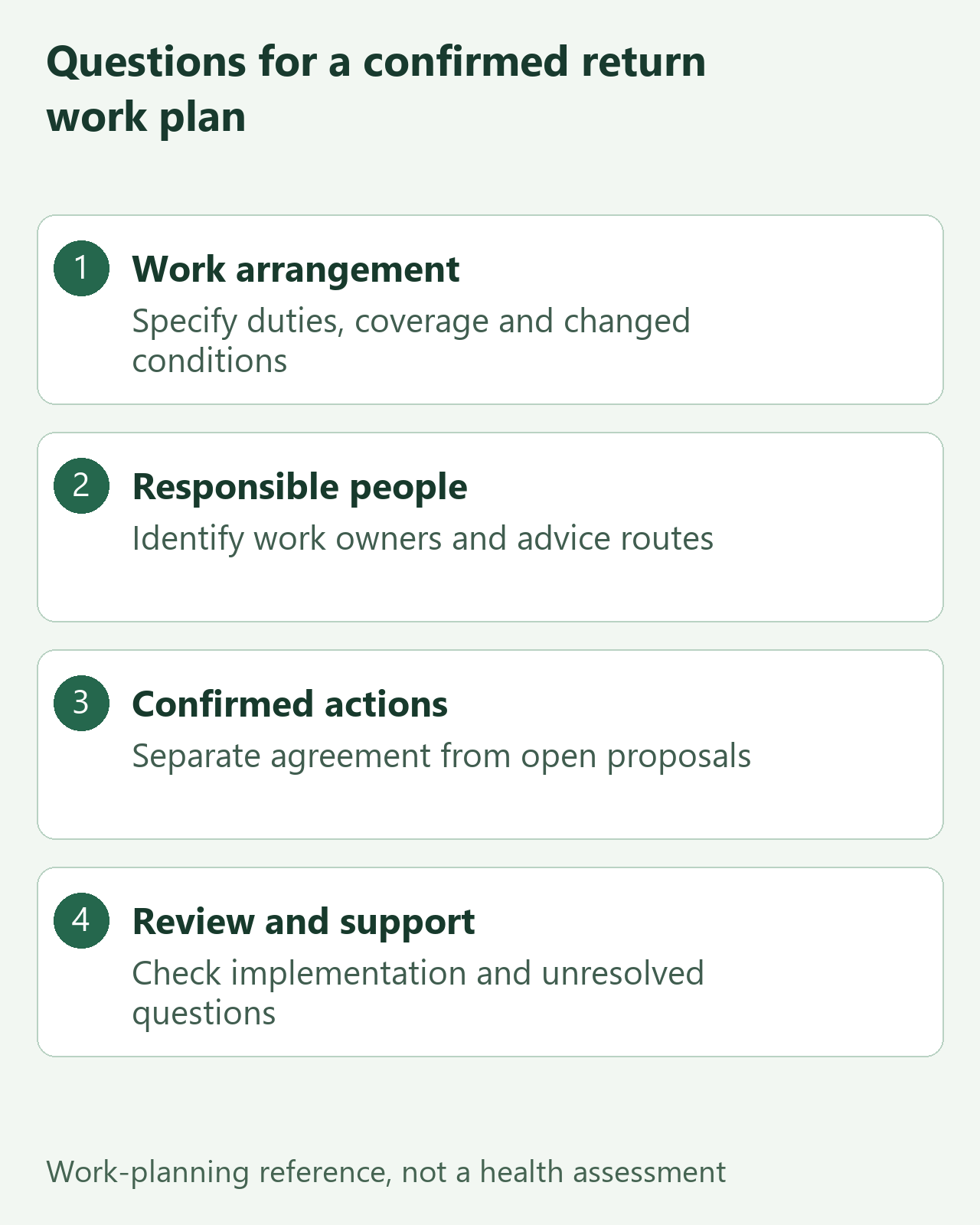
A return discussion should turn broad intentions into a confirmed work arrangement: what you will do, what has changed, who will implement the plan and how unanswered questions will be handled. A work plan does not establish medical fitness or replace individual advice.
Separate the work plan from health and policy decisions
If you are preparing to return after leave you describe as burnout leave, begin with the actual arrangement that needs discussing. The label alone does not tell you which duties are appropriate, whether a health assessment is required or which local policies apply. Those questions may involve your employer, occupational health, a treating professional or another relevant person in your setting.
WHO classifies burnout in ICD-11 as an occupational phenomenon, rather than a medical condition. That classification does not mean that symptoms are harmless or that another health condition is absent. It cannot establish your individual fitness to return. This article helps prepare work questions; it does not prescribe hours, a phased-return timetable or a clinical recovery target.
WHO's mental-health-at-work fact sheet describes organizational interventions and work adjustments. Its return-to-work discussion concerns programs for workers returning after absences associated with mental-health conditions and combines work-directed support with ongoing clinical care. Do not treat that general guidance as evidence that a particular arrangement is suitable for every person using the word burnout.
Ask what the first work arrangement actually includes
On a narrow screen, scroll the table sideways to read all columns.
| Work-plan area | Question to ask | Confirmation to look for |
|---|---|---|
| Duties and outcomes | Which responsibilities are included, and which are temporarily covered elsewhere? | Specific tasks, owners and any agreed exclusions. |
| Workload and timing | How will the agreed duties fit the arrangement, and who decides if new work arrives? | Usable work time, priorities and a route for changed requests. |
| Coverage and handover | Who holds unresolved work, urgent requests and duties not assigned to me? | Named coverage and an accessible handover route. |
| Workplace changes | Have tools, reporting lines, procedures or expectations changed during leave? | Needed updates, access and training, with an owner. |
| Contact and support | Who is my work contact, and which channel handles a concern? | A usable contact and the applicable support route. |
| Review and changes | When will we review the arrangement, and who can authorize a change? | An agreed review and decision owner, rather than an automatic progression. |
Ask for the form of confirmation appropriate to your workplace. Not every detail needs a separate formal document, but the arrangement should be understandable to the people implementing it. A sentence such as ‘We will ease you back in’ leaves duties, coverage and decision authority unspecified.
Check whether the earlier work problem has changed
If excessive demands, conflicting responsibilities, missing support or limited control contributed to your concern, ask what is different in the proposed arrangement. ‘Workload will be lighter’ needs an explanation of which tasks, deadlines, coverage or resources have changed. The same duties arriving through fewer working hours may still leave a practical capacity problem.
HSE's work-design standards identify demands, control, role and support as areas to address. Use them to organize questions about the job, not to calculate a personal readiness score. You can ask whether a previous bottleneck has been removed, whether new requests have an owner and what happens when the agreed plan no longer fits.
Some facts may not yet be known. Label them as outstanding, identify who will check them and keep them separate from confirmed parts of the arrangement. An intention to hire additional cover is different from cover being available on the return date.
Turn an adjustment into an implementable arrangement
If an adjustment is being considered through the applicable process, ask what it changes in practice and who will implement it. WHO gives examples such as flexible working arrangements, modified tasks, time for health appointments and supportive meetings. These are general examples, not a prescription for your schedule or a determination of local entitlement.
An illustrative proposal might involve a narrower initial task scope. The useful questions are: Which tasks are included? Who holds the excluded work? Who updates the work queue? What happens if urgent requests arrive? What is the agreed review process? The specific arrangement must be considered and confirmed by the appropriate people, with individual health advice where relevant.
Do not assume that a fixed number of days automatically leads to more hours or duties. Ask how a change would be reviewed and authorized. If individual advice or policy requirements are unclear, keep the question open for the responsible professional or process rather than filling it with a website rule.
Clarify contact before urgent work arrives
Agree who receives routine work questions, who can change priorities and what channel is used for an urgent operational issue. Check whether these are the same person. A colleague helping with handover may not have authority to approve an adjustment or change a deadline.
It can also help to clarify response expectations during the agreed work arrangement. A work contact plan should not quietly restore unrestricted availability during time that is covered by another arrangement. Any necessary operational coverage, policy or safety requirements need the appropriate owner to resolve them.
Personal health details do not need to be included in every scheduling message. Ask which information is needed, by whom and through which appropriate channel. The level of disclosure and any required documentation depend on your situation and local process; this article cannot decide them.
Plan a review that checks actual implementation
At an agreed review, compare the plan with what happened: duties assigned, incoming requests, coverage, access, support and decisions that remained unanswered. This is a check on the work arrangement. It is not a symptom test or a way for this website to approve continued work.
Use a short record: ‘Agreed arrangement: … What actually happened: … Unresolved work question: … Change needing confirmation: … Responsible person and follow-up: …’ If a previously excluded duty has returned without a decision, raise that change through the appropriate route. If a health concern develops or changes, seek relevant professional advice rather than trying to resolve it through workload notes alone.
Bring unanswered questions to the right person
Work scope, handover and priority questions may belong with the manager or project owner. Questions about organizational policy or an adjustment process may involve HR or another designated role. Individual health advice and any assessment required for your circumstances may involve a treating professional or occupational health. Ask for the correct route when responsibilities are unclear.
You do not need to achieve a self-test score, wait for a fixed period or complete this worksheet before requesting support. A confirmed work arrangement is useful preparation, but it does not guarantee recovery, prevent every difficulty or establish that health concerns have been resolved.
Keep the blank record as preparation
The downloadable text record separates confirmed arrangements, proposals and outstanding questions. Fill in only what you know, and use the appropriate storage and sharing practices for work and personal information. There is no need to send your completed record to this website.
Before the discussion ends, check that each unresolved issue has a responsible person or an identified route. Where no answer has been given, keep it visibly unresolved rather than treating silence or a general welcome-back message as confirmation.
Examples to work through
These fictional work examples show how to identify the decision and its status.
A warm welcome leaves the duties unclear
An illustrative worker is told that the team will ‘take it slowly.’ They ask which duties are included, which tasks remain with cover and who will handle new requests. The welcome is supportive, but a specific arrangement still needs confirmation; it is not medical clearance or an automatic timetable.
Reduced time with an unchanged queue
An illustrative proposal changes available work time without identifying work to be reassigned. The worker asks how the queue will fit the arrangement and who can change priorities or coverage. They do not assume that fewer hours alone resolve the workload, and this example does not prescribe a particular schedule.
The workplace has changed during leave
An illustrative returning employee finds a new reporting line and an unfamiliar system. They record the access and training needed, the owner of each action and the work affected until it is ready. This keeps an implementation issue distinct from a judgment about the employee's health or capability.
A work question and a health question need different answers
An illustrative employee has both an unresolved coverage question and a concern about symptoms. They raise coverage with the authorized work owner and seek relevant individual health advice through the appropriate route. An agreed handover does not answer the health question, and a symptom checklist on a website would not confirm the work arrangement.
Return-to-work arrangement questions: blank preparation record
Use this optional text record to separate confirmed work facts, proposals and unanswered questions. Save and share it through the appropriate process. Downloading it does not send your completed notes to this site, and it does not assess health or fitness.
Frequently asked questions
How do I know whether I am ready to return?
This page cannot determine individual readiness or fitness. Discuss relevant health advice, any required assessment, local process and the proposed work arrangement with the appropriate people. A work-plan worksheet or self-test score cannot provide medical clearance.
Should every return use a phased schedule?
There is no universal schedule in the sources used here. Whether an arrangement is appropriate depends on individual circumstances, relevant advice and the applicable workplace process. Ask how duties, coverage and review would work in any proposal instead of copying a fixed timetable.
What if the causes of the earlier workload problem remain?
Make the remaining work conditions specific: duties, demand, decision authority, conflicting expectations or missing support. Ask what change is actually confirmed and who will implement it. Keep unresolved issues open and use the appropriate support or advice route; leave alone does not prove the job conditions changed.
Do I have to disclose personal health details to the whole team?
This article cannot determine disclosure requirements. Ask what information is needed, who needs it and which channel is appropriate under your local process. A broadly shared work plan can often focus on duties, coverage and contacts, while relevant personal discussions use the designated route.
Choose the next reading task
Sources and what they support
- WHO: Mental health at work (15 September 2026)
Organizational risks, work-directed support and adjustment examples. Return-to-work guidance concerns absences associated with mental-health conditions; no individual schedule, clinical clearance or local entitlement is inferred.
- WHO: Burn-out an occupational phenomenon (2019)
ICD-11 classification and its occupational context. It does not validate website scores, exclude another health condition or establish individual fitness.
- HSE: Management Standards — Demands
Workload, work patterns and achievable demands in relation to agreed working hours. UK work-design guidance; no clinical threshold or universal duration rule.
- HSE: Management Standards — Role
Clear responsibilities, compatible requirements and ways to raise uncertainty or conflicts. It does not decide which individual request has priority.
- HSE: Management Standards — Control
Influence over how work is done, where possible, and consultation about work patterns. It does not authorize bypassing required safeguards or another person’s decision.
- HSE: Management Standards — Support
Usable organizational support, resources and constructive feedback. It does not guarantee that a proposal will be approved.
Work-planning information based on the listed sources. Local procedures and individual advice may be needed. The worksheet does not assess health, determine rights or provide individual clearance. No clinical reviewer is claimed for this article.